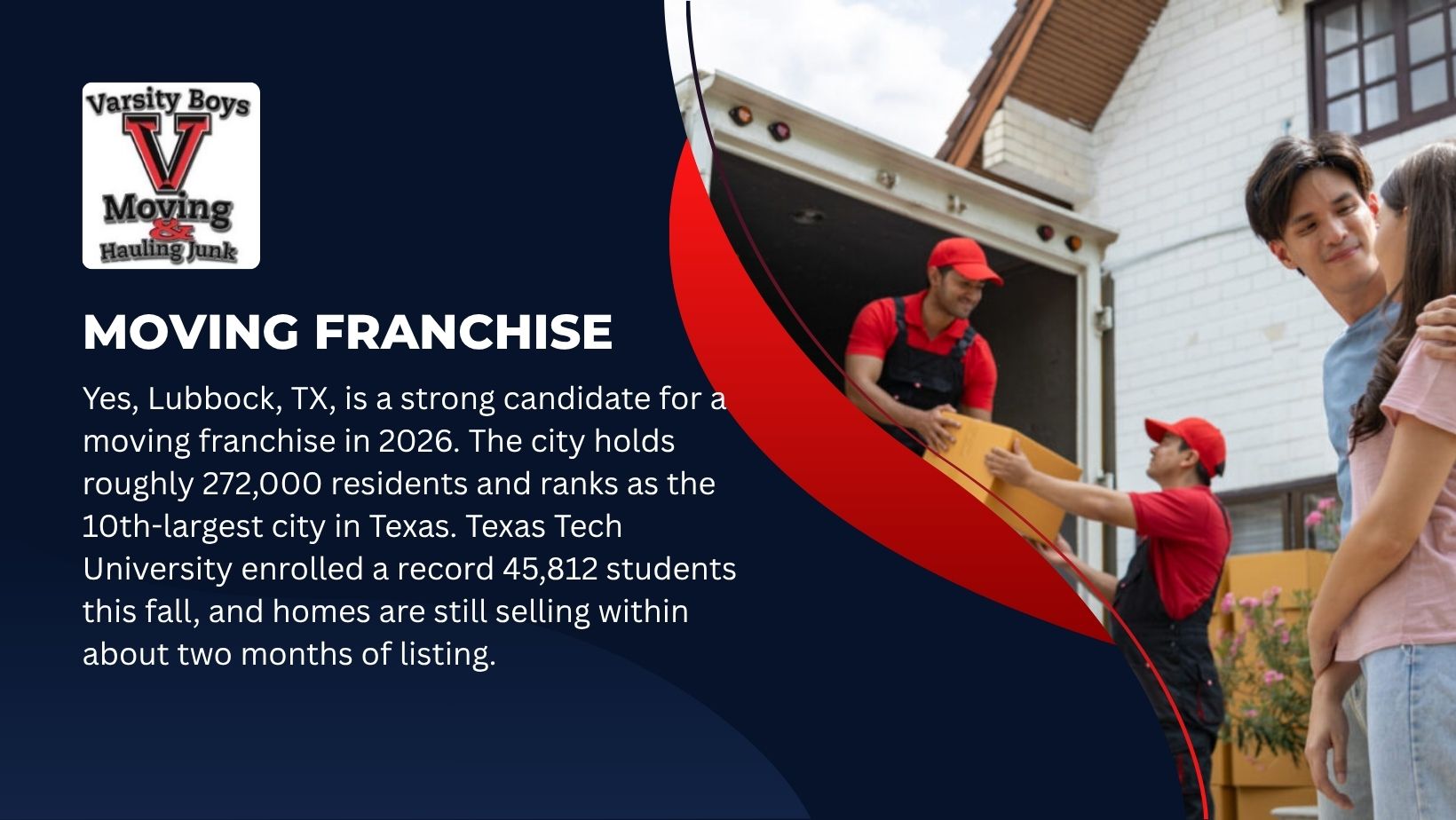
Yes, Lubbock, TX, is a strong candidate for a moving franchise in 2026. The city holds roughly 272,000 residents and ranks as the 10th-largest city in Texas. Texas Tech University enrolled a record 45,812 students this fall, and homes are still selling within about two months of listing. That combination of steady population growth, a large recurring student-move cycle, and an active housing market creates consistent demand for a professional moving and junk-hauling business, not just a seasonal bump.
This guide walks through what to evaluate before choosing Lubbock, how franchise ownership compares with starting independently, what a moving franchise actually costs to plan for, and what a Varsity Boys Moving & Hauling Junk franchise specifically offers in this market. It’s written for entrepreneurs who are researching moving and junk-hauling franchise opportunities in West Texas and want a realistic read on the market before talking numbers with a franchise development team.
Why Lubbock May Be Worth Considering for a Moving Franchise
Lubbock combines a growing population, a major university, and a regional hub economy—three factors that keep local moving companies busy year-round instead of just during peak season.
Understanding the Local Market
Lubbock is the largest city in the South Plains and serves as the economic, medical, and educational hub for a wide stretch of West Texas, pulling in residents and businesses from smaller surrounding counties. The city’s population grew about 5.8% between 2020 and 2025, a steady, reliable pace rather than a one-time spike, and it now ranks as the 10th-largest city in the state.
Because Lubbock functions as a regional hub, its effective customer base extends well beyond the city limits into the smaller South Plains towns that depend on it for shopping, medical care, and services. That regional pull role, sometimes called Lubbock’s “Hub City” status, means a moving and hauling business based in Lubbock can realistically draw jobs from a wider trade area than the population figure alone suggests.
Residential Moving Demand
Lubbock homes are selling in roughly 60 days on average, with recent median sale prices in the $239,000–$255,000 range and only a few months of housing inventory on the market, signs of an active market with regular turnover rather than a stagnant one. Every closed sale, lease signing, and apartment turnover is a potential move, and Lubbock’s rental market absorbs a large share of that traffic each August and January as students and young professionals relocate near campus and the medical district.

Commercial and Other Moving Opportunities
Beyond households, Lubbock’s employer base anchored by Texas Tech University, Texas Tech University Health Sciences Center, Covenant Health, and UMC Health System generates recurring office, lab, and facility moves that aren’t tied to the residential calendar at all. Small businesses relocating within the city’s growing commercial corridors, plus the broader agriculture and logistics economy that runs through the South Plains, add additional, less seasonal commercial work for a crew that can handle more than household boxes. New retail and multifamily construction around the city also tends to generate move-in waves that a locally based crew is better positioned to catch quickly than an out-of-town competitor.
What Should You Evaluate Before Choosing Lubbock for a Franchise?
Before committing to any territory, evaluate local demand, existing competition, and the operational realities of running a crew-based service business day to day.
Local Customer Demand
Lubbock’s population growth and Texas Tech’s enrollment gains, up more than 12% over the past two years alone, point to rising demand for local moving services rather than a flat or shrinking market. A growing student body also means a growing off-campus rental market, which typically turns over at least once a year per unit.
Competition in the Moving Market
Lubbock already has a mix of independent local movers, regional operators, national van lines, and at least one student-labor-focused mover built specifically around the university calendar. That doesn’t rule out entering the market; it means a new franchise needs a clear way to stand out, whether through pricing transparency, a combined moving-and-junk-hauling offer, or faster response times than competitors can match. Reviewing competitors’ online reviews for recurring complaints, such as late arrivals or unclear pricing, is a practical way to spot exactly where a new entrant can differentiate before a single truck ever leaves the lot.
Service Area and Territory Potential
A Lubbock-based franchise can typically serve the city itself plus surrounding South Plains communities such as Wolfforth, Shallowater, and Levelland, giving an owner a realistic radius for both moving and hauling jobs across Lubbock County without excessive drive time between calls.
Staffing and Operational Considerations
Texas Tech’s large student population is a built-in labor pool for a crew-based business, similar to how other movers in the market already recruit and market around student labor. Seasonal spikes around move-in and move-out weekends require planning crew schedules and part-time staffing around the academic calendar rather than a standard year-round shift pattern.
What Can Make a Moving Franchise Attractive in Lubbock?
A franchise model can shorten the runway between deciding to open a business and generating revenue, compared with building a moving company from nothing.
Established Business Systems
Franchisees typically inherit pricing structures, booking workflows, estimate processes, and operational checklists that have already been tested in other markets, rather than developing them through trial and error on their own dime. That can include everything from how a crew handles a damage claim to how a dispatcher schedules back-to-back jobs without double-booking a truck.
Brand and Marketing Support
A recognized name and centralized marketing resources can help a new Lubbock location generate leads faster than an unknown independent competitor starting from zero online reviews and zero local search visibility.

Training for New Franchise Owners
Structured onboarding, often combining initial hands-on training with an operations manual and ongoing support access, gives first-time business owners a framework to run crews, quote jobs, and handle customer service instead of a blank page.
Moving and Junk Removal Service Model
Pairing moving with junk hauling gives a franchise two related revenue streams from the same trucks and crews. A household move that leaves behind an old mattress or broken furniture becomes a same-visit hauling job instead of lost revenue.
How Does Lubbock Compare With Starting an Independent Moving Business?
Both paths can work in Lubbock, but they carry different timelines, risks, and support levels worth weighing honestly.
Building a Brand From Scratch
An independent mover has to build name recognition, a review history, and local trust from zero, a process that can take a few years in a market where established movers already have a head start on search visibility and word-of-mouth.
Developing Operational Systems
Independent owners must design their own pricing, dispatch, hiring, and training processes, often learning through costly early mistakes, from underpriced jobs to staffing gaps, rather than following a system that’s already been refined elsewhere.
Generating Leads and Marketing
Without a recognized brand, independent movers depend heavily on paid ads, word-of-mouth, and slow, organic search growth to fill their calendar, which can mean inconsistent bookings in the first year or two.
Franchise Support vs. Going Independent
A franchise trades some independence for a support structure, training, marketing resources, and an established operating model that can reduce the trial-and-error period of the first one to two years in business.
What Should You Consider About the Financial Side?
Every franchise has its own cost structure, and the only accurate numbers come from that brand’s official Franchise Disclosure Document (FDD), not blog estimates or general industry averages.
Initial Investment
Initial investment for a moving and junk-hauling franchise typically covers the franchise fee, a truck or trucks, equipment, signage, insurance, initial marketing, and working capital. Ask any franchise you’re considering for its current FDD Item 7 estimated initial investment range rather than relying on a rough figure quoted elsewhere.
Ongoing Fees and Operating Costs
Most franchise systems charge an ongoing royalty, typically calculated as a percentage of gross revenue, and may also collect into a shared marketing or brand fund. Confirm the exact percentages, what they cover, and how they’re billed in the FDD and franchise agreement before assuming anything.
Equipment, Trucks, and Staffing
Budget for moving trucks, dollies, blankets, straps, and other equipment, plus payroll for crew members and standard business insurance such as commercial auto and general liability coverage. Costs scale with how many jobs a Lubbock territory can realistically support and how quickly an owner plans to add a second truck.
Working Capital and Cash-Flow Planning
Plan for working capital beyond the initial investment to cover payroll, fuel, and marketing during the ramp-up period before the business reaches steady bookings, since most new service businesses take time to build a consistent job calendar.
What Services Could a Moving Franchise Offer in Lubbock?
A combined moving and hauling model gives a Lubbock franchise several service lines to sell to the same customer base instead of relying on one type of job.
Residential Moving Services
Local household moves, single-item and small-load moves, apartment turnovers tied to Texas Tech’s semester calendar, and full-service packing cover the bulk of day-to-day bookings for most residential customers.
Commercial Moving Services
Office relocations, small-business moves, and facility transitions connected to Lubbock’s healthcare and education employers round out the commercial side, often with larger job sizes and less price sensitivity than residential work.

Junk Removal and Hauling
Furniture removal, appliance pickup, garage and estate cleanouts, hoarding cleanup, and construction or landscaping debris hauling let the same trucks and crews generate revenue on days when moving bookings are lighter.
Additional Service Opportunities
Labor-only moving help for customers who rent their own truck, seasonal cleanouts around spring and the end of each semester, and short-term storage coordination are natural add-ons once a franchise has an established crew and a loyal customer base to upsell. Each of these add-ons tends to require little extra equipment, which keeps margins healthy compared with adding an entirely new service line from scratch.
What Should You Look for in a Lubbock Moving Franchise?
Not every franchise opportunity is structured the same way, so compare these factors carefully before signing anything.
Training and Ongoing Support
Look for a defined onboarding program and continued access to operational support after launch, not just a manual handed over at signing and never revisited.
Marketing and Lead Generation
Ask exactly what marketing the franchisor provides, such as a website, local SEO, paid ads, and review management, versus what the owner is expected to fund and run locally out of pocket.
Territory and Expansion Terms
Confirm how the Lubbock territory is defined, whether it’s exclusive, and what happens if the franchisor wants to add another location nearby as the market grows.
Franchise Agreement and FDD
Read the full Franchise Disclosure Document, not just a summary. It covers fees, territory rights, and termination terms in the level of detail federal and state law require franchisors to disclose to prospective owners.
Reputation and Franchisee Experience
Talk to current franchisees in other markets about their real experience with support, marketing, and day-to-day profitability before committing your own capital.
Why Consider a Varsity Boys Moving & Hauling Junk Franchise in Lubbock?
Varsity Boys Moving & Hauling Junk built its model in San Antonio starting in late 2020 and has since expanded its franchise opportunities into other Texas markets, including Houston, with a brand built around combining moving and junk hauling under one roof.
Combined Moving and Junk Removal Model
The brand pairs residential and commercial moving with junk hauling, appliance recycling, and debris pickup under one operation, giving a Lubbock franchisee two service lines from a single crew and fleet instead of specializing in only one.
Training and Franchise Support
Franchise owners work from a system built on several years of Texas operating experience rather than starting entirely from scratch, covering day-to-day processes for booking, dispatch, pricing, and customer service that have already been tested in other cities.
Marketing and Operational Resources
The franchise program is positioned to provide guidance on operations and marketing, so new owners aren’t building a website, reviewing strategy, or leading a pipeline entirely on their own from day one.
Building a Local Business in Lubbock
A Varsity Boys franchise in Lubbock would pair the brand’s existing systems and Texas market experience with the city’s Texas Tech-driven move cycle and steady population growth, a market fit worth evaluating directly with the franchise development team.
Questions to Ask Before Opening a Moving Franchise in Lubbock
Bring these questions to any conversation with a franchise development team, and don’t settle for vague answers.
Questions About Investment
What is the total estimated initial investment range in the current FDD, what does it include, and how much additional working capital is recommended beyond that figure?
Questions About Territory
How is the Lubbock territory defined on a map, is it protected from another franchisee opening nearby, and does it include the surrounding South Plains towns?
Questions About Support
What training, marketing, and operational support is provided in the first 90 days versus on an ongoing basis, and is that support delivered in person, remotely, or both?
Questions About Growth
Is there room to add a second truck, additional territory, or new service lines as the business grows, and what does that expansion process typically look like?
How to Decide Whether a Moving Franchise in Lubbock Is Right for You
Weigh your own goals against what the market and the franchise both offer before moving forward with any franchise development team.
Assess Your Goals and Resources
Consider your available capital, whether you plan to run day-to-day operations yourself or hire a manager, and your comfort with a crew-based, physical service business rather than a desk job.
Compare Franchise Opportunities
Look at more than one moving or home-service franchise before deciding. Compare investment ranges, support structures, and territory terms side by side rather than evaluating a single brand in isolation.
Review the FDD and Agreement
Have a franchise attorney or advisor review the FDD and franchise agreement before signing, and don’t rely on marketing materials alone for financial figures or projected earnings.
Speak With the Franchise Team
The clearest way to know if Lubbock fits a specific brand’s model is a direct conversation with that franchise’s development team about territory availability and timelines.
FAQs About Moving Franchise Opportunities in Lubbock
Is Lubbock a good city for a moving franchise?
Lubbock’s population of roughly 272,000, its steady 5.8% growth since 2020, and Texas Tech’s record enrollment of over 45,000 students make it a market with consistent, recurring moving and hauling demand rather than a seasonal blip.
How much does a moving franchise cost?
Initial investment varies by brand and typically covers the franchise fee, trucks, equipment, insurance, and working capital. The accurate figure for any specific franchise is in that brand’s official FDD, not a general estimate found online, so ask for the current FDD Item 7 range before assuming any number applies to a particular brand or market.
Do I need moving industry experience?
Most moving franchises are built for owners without prior industry experience and provide training to cover day-to-day operations, though comfort managing a crew-based, physical business is genuinely helpful.
What support does a moving franchise provide?
Support commonly includes training, marketing resources, and operational systems, though the specifics, from lead generation to ongoing coaching, vary by franchisor and should be confirmed directly before signing.
How can I learn more about a Varsity Boys franchise in Lubbock?
Reach out to the Varsity Boys Moving & Hauling Junk franchise team directly to discuss Lubbock territory availability, current investment details, and next steps in the process.
Is a Moving Franchise in Lubbock Right for You?
Lubbock’s population growth, Texas Tech’s expanding enrollment, and an active housing market all point to steady demand for moving and junk-hauling services. Whether that demand translates into the right opportunity for you depends on your goals, available capital, and how a specific franchise’s support and territory terms line up with what Lubbock offers. Franchise ownership isn’t the only path into this market, but for many first-time business owners it shortens the distance between deciding to start and actually generating revenue, especially in a city where demand is already growing on its own. The next step is less about researching Lubbock further and more about getting real numbers, real territory maps, and real support details from a specific franchise team.