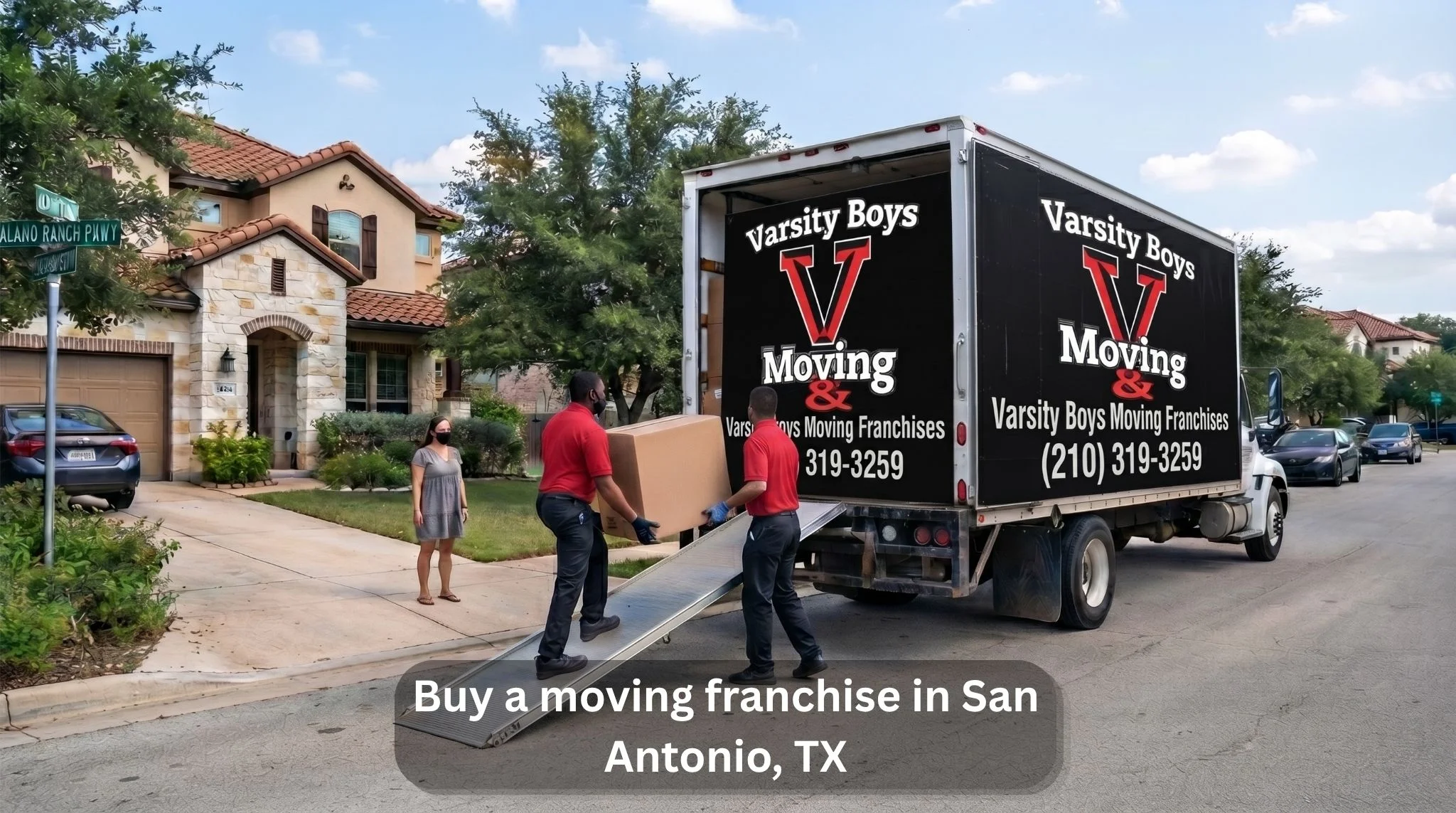
If you’re serious enough to buy a moving franchise in San Antonio, you’ve probably already read the pitch decks. What you likely haven’t seen is a straight answer on what it costs, how people actually finance it, and what the calendar looks like between your first phone call and your first paying job. That’s what this guide covers – no filler, no recycled brochure copy.
San Antonio has become one of the more talked – about markets for moving franchises for reasons that are easy to verify: steady population growth, a large military relocation cycle tied to Joint Base San Antonio, and housing costs that haven’t spiked the way Austin’s have. But a good market doesn’t buy the truck, pay the crew, or cover your first slow month. That part comes down to budgeting the investment correctly and financing it in a way that doesn’t put your household finances at risk. Let’s get into the specifics.

What It Actually Costs to Buy a Moving Franchise
Every franchisor is legally required to disclose total investment in Item 7 of its Franchise Disclosure Document (FDD). That number – not the figure on a marketing page – is the one to plan against.
A few things worth knowing before you anchor on any single number. First, the franchise fee is almost always the smallest piece of the total – treating it as “the cost” is the single most common budgeting mistake first-time buyers make. Second, comparable brands in the moving and junk-hauling space have shown total investment ranges stretching from roughly $125,000 on the lower end up toward $355,000 for multi-service concepts that combine moving with hauling, according to recent FDD disclosures reviewed across the category. Third, working capital gets underestimated more than any other line item – six months of payroll and fuel in a metro the size of San Antonio adds up fast, and running short here is what actually sinks new owners, not the sticker price of the franchise fee.
Franchise Financing for a Moving Business in San Antonio
Almost nobody pays the full investment in cash, and franchisors generally expect buyers to bring a portion of it as liquid capital while financing the rest. Here’s what that actually looks like right now.
SBA 7(a) Loans
The SBA 7(a) loan is the most common financing path for franchise buyers, and it can be used for the franchise fee, trucks and equipment, and working capital. Loan amounts run up to $5 million, with repayment terms up to 10 years for standard business purposes. As of 2026, expect all-in interest rates in roughly the 9–11% range given current prime rate levels, which is still typically more favorable than most conventional small-business financing alternatives.
One important detail buyers often miss: the franchise brand must appear on the SBA Franchise Directory for its buyers to access SBA-backed loans. The directory was reintroduced in August 2025 after a multi-year gap, and it went through a re-certification deadline in June 2026 – some brands were removed from the list at that point. Before you count on SBA financing, confirm directly that the specific brand you’re evaluating currently holds an active directory listing, not just that it did last year.
SBA 504 Loans
If a chunk of your investment is going toward larger equipment purchases or a facility, the SBA 504 program pairs a conventional lender with a Certified Development Company to offer below-market fixed rates. It’s less commonly used for moving franchises than 7(a) financing, since most moving operations don’t require owned real estate, but it’s worth asking about if your plan includes a dedicated warehouse or storage facility.
What Lenders Look For
Regardless of loan type, most SBA lenders evaluate the same core factors:
- Personal credit score, typically 680 or higher for standard 7(a) approval
- Available collateral and liquid capital to cover the required equity injection
- Relevant business or management experience, though direct moving-industry experience is rarely required
- Time to close – realistically 8 to 10 weeks from lender submission to funding, faster for territory-based, non-real-estate businesses like moving franchises compared to brands requiring a commercial lease
Other Financing Paths Worth Knowing
- Seller or franchisor financing: Some franchisors offer partial financing or fee discounts, particularly for veterans – worth asking about directly during discovery calls.
- ROBS (Rollover for Business Startups): Lets buyers use retirement funds to finance a franchise without early-withdrawal penalties, though it carries its own compliance requirements and isn’t right for everyone.
- Home equity or HELOC financing: An option for buyers with significant home equity, though it puts personal real estate at risk if the business underperforms.
The right mix depends on your liquidity, credit profile, and risk tolerance – a conversation worth having with a franchise-experienced lender before you fall in love with a specific brand or territory.

How to Start a Moving Franchise in San Antonio: The Actual Steps
Buyers rarely get a clear picture of what happens between “I’m interested” and “I’m running my first job.” Here’s the realistic sequence.
- Initial inquiry and discovery call. You’ll talk through territory availability, investment range, and whether your background fits what the franchisor looks for. This is also where you should start asking the hard verification questions covered later in this guide.
- Review the FDD. Franchisors are legally required to provide this document at least 14 days before you sign anything or pay any money. Read Item 7 (investment) and Item 19 (financial performance representations, if disclosed) closely.
- Talk to current franchise owners. Most FDDs include a list of current and former franchisees. Call several, not just the ones the franchisor suggests.
- Legal and financial review. Have a franchise attorney review the FDD and franchise agreement before signing. This step gets skipped more than any other, and it shouldn’t be.
- Secure financing. Whether SBA, seller financing, or a combination, get your loan process moving early – it can take 8 to 10 weeks or more.
- Sign the franchise agreement and pay the initial fee.
- Complete initial training. This typically covers operations, pricing, staffing, local marketing, and the systems you’ll use day-to-day.
- Set up operations. Secure trucks and equipment, finalize insurance and Texas moving permits, hire your initial crew, and establish your local business presence.
- Grand opening and first jobs. Most owners are running their first paid moves within a few months of signing, though the exact timeline depends on financing speed and equipment lead times.
Realistically, budget four to six months from signing to opening day, longer if financing or equipment delivery runs behind schedule.
What It Takes to Become a Moving Franchise Owner
Franchisors in this category generally aren’t looking for movers – they’re looking for operators. The skills that matter most:
- People management. You’ll be hiring, scheduling, and retaining crews, often in a physically demanding job with real turnover challenges.
- Basic financial literacy. Reading a P&L, managing cash flow through slow months, and understanding your cost per job matter more than knowing how to wrap a couch.
- Local marketing instinct. Even with brand support, local visibility – reviews, referral relationships with realtors and property managers, local SEO – drives a meaningful share of job volume.
- Comfort with physical, logistics-heavy operations. You don’t need to load trucks yourself, but you do need to understand routing, scheduling, and claims handling well enough to manage people who do.
Most moving franchise systems are explicitly built for owners without direct industry experience – the training and operating systems are there to fill that gap. What they can’t fill is a mismatch in temperament: if you want a business you can run remotely with minimal involvement, a labor-intensive service business like moving is a harder fit than it might look on paper.
Moving Franchise Investment in San Antonio: What Actually Drives Returns
Total investment tells you what you’ll spend. It doesn’t tell you what you’ll make – that depends heavily on territory quality and local demand, which is where San Antonio’s specific market dynamics matter.
San Antonio combines two demand sources most cities only have one of: sustained civilian population growth and a large, recurring military relocation cycle tied to Joint Base San Antonio’s permanent-change-of-station schedule. That second driver runs on a fairly predictable annual calendar and holds up better through economic softness than purely civilian-driven demand does. A territory well-positioned relative to base housing corridors and the metro’s fastest-growing suburbs is worth more, in practical terms, than an identical investment in a market with population growth but no comparable institutional demand anchor.
If a franchisor offers Item 19 financial performance data, that’s the most reliable way to gauge realistic revenue expectations – treat any brand unwilling to share it, or unwilling to explain why it doesn’t, as a reason to ask harder questions before you commit capital.
Questions to Ask Before You Sign
A short list, but each one matters:
- What does Item 7 disclose as the total investment range, and what’s driving the variance?
- Is the brand currently active on the SBA Franchise Directory?
- What financing support or discounts does the franchisor offer directly?
- What does the first 90 days of operational support actually look like?
- How is the San Antonio territory sized, and what’s the competitive density already in it?
- Can I speak directly with two or three current owners, including at least one in a comparable market?
Red Flags to Watch For
- Reluctance to share Item 19 data or explain its absence
- Pressure to sign before your financing or legal review is complete
- Vague or shifting answers about territory boundaries
- No clear answer on SBA Franchise Directory status when asked directly
- High franchisee turnover with no straight explanation
Final Thoughts
Buying a moving franchise in San Antonio is a realistic, well-supported path into business ownership for the right buyer – the market fundamentals are genuinely strong, and the cost structure is lower-overhead than most franchise categories. But the (210) 319-3259 that matters isn’t the one on the website. It’s the one in Item 7, financed responsibly, against a territory that’s actually sized for the demand San Antonio offers. Do the verification work up front, and the investment has a real shot at paying off the way the pitch says it will.
FAQ
How much does it cost to buy a moving franchise in San Antonio?
Total investment typically falls between $80,000 and $300,000, covering the franchise fee, trucks and equipment, insurance, and working capital. The exact figure is disclosed in Item 7 of the franchise’s FDD.
Can I use an SBA loan to buy a moving franchise?
Yes, if the brand is listed on the SBA Franchise Directory. SBA 7(a) loans can cover the franchise fee, equipment, and working capital, with terms up to 10 years and current rates roughly 9–11%.
Do I need moving industry experience to buy a franchise?
No. Most moving franchise systems are built for owners without direct industry background. People management and basic financial literacy matter more than hands-on moving experience.
How long does it take to open a moving franchise after signing?
Most owners open within four to six months of signing, depending on financing speed, training schedules, and equipment lead times.
What’s the difference between the franchise fee and total investment?
The franchise fee is a one-time payment for brand rights and training, usually $15,000–$50,000. Total investment includes that fee plus trucks, insurance, working capital, and marketing – often several times the fee alone.
What should I ask before signing a moving franchise agreement?
Ask for Item 7 and Item 19 FDD data, confirm SBA Franchise Directory status, ask about territory sizing and competitive density, and speak directly with current franchise owners before signing anything.